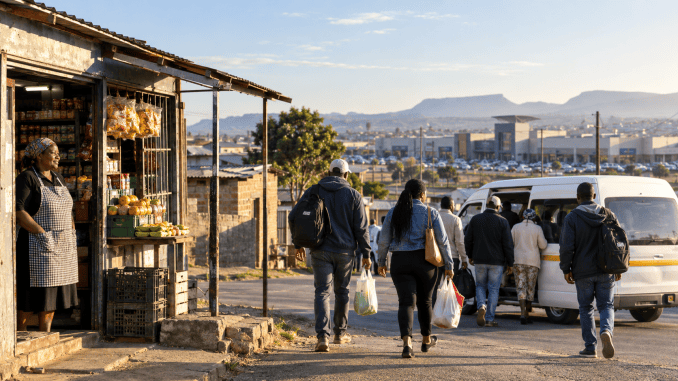
Every day, millions of residents leave South Africa’s townships to work, study, collect medicine or shop. Many also take their household spending with them—not simply because they prefer distant malls and town centres, but because the goods, prices, stock or services they need are not reliably available close to home.
That pattern is placing the township economy South Africa depends on for jobs and livelihoods under sustained pressure. The Competition Commission’s first Rural and Township Economy Report, launched in Johannesburg on 3 September 2026, gives the problem a clear economic frame: when residents must buy elsewhere, money “leaks” out of the local economy instead of circulating among local households and businesses.
The report’s headline finding needs to be stated carefully. It says approximately 50% of surveyed rural and township households spend outside their local economies across various sectors. It does not conclude that precisely half of every rand earned in every township leaves, nor does it calculate a single national rand value for the leakage. Even with that qualification, the shopping patterns are serious: in large townships, 41% of households bought food outside the local economy, 47% went elsewhere for building and hardware products, and 43% did so for pharmacy services.
For families already living on narrow margins, the price on the shelf is only part of the bill. Taxi fares, travel time and the risk of returning home without everything they need create a second, largely invisible cost.
Table of Contents
1. What the Spatial Leakage Report examines
The formal title is the Rural and Township Economy Project 2026. It was produced by the Competition Commission of South Africa using existing research, the Commission’s enforcement experience and two nationwide studies it commissioned: a consumer survey and a business survey conducted by RedFlank during 2025 and 2026.
The research considers far more than household shopping. It examines:
- where consumers buy different goods and services, and how far they travel;
- which transport modes they use for shopping;
- how township and rural businesses obtain stock and other inputs;
- whether small firms can sell through malls, major retailers and online channels;
- how prices, product range, quality and reliability affect consumer choices; and
- How permits, licences, zoning, municipal bylaws, tax compliance and infrastructure affect business growth.
In plain language, spatial leakage is money that leaves a local area because goods and services are sourced elsewhere. If a resident buys groceries from a local shop, some of that income can pay a local worker, support another local supplier or finance an expansion. When the purchase happens outside the township, fewer of those follow-on transactions take place locally. Economists describe this as a weaker local multiplier.
The report also connects today’s township shopping patterns to apartheid spatial planning. Townships were deliberately separated from economic centres and productive land. Distance, fragmented infrastructure and restricted commercial development are therefore not accidental features of the present market; they are part of its inherited design.
2. Five pressures driving money out of township economies
2.1 Essential goods and specialist services are unevenly available
Food may be available nearby, but the right pack size, brand, medicine, hardware item or specialist service may not be. Pharmacy products are a telling example: small or informal traders generally cannot stock regulated medicines without the required licences and professional capacity. This leaves some residents with no practical option but to travel.
The same problem affects stationery, electronics, furniture, building materials, banking and healthcare. The report finds outward shopping is strongest in categories where consumers compare price, quality, variety and trusted brands, although meaningful numbers also travel for essentials such as food and pharmacy services.
2.2 Local shops can face higher input costs
Many kasi retail challenges begin before the customer walks through the door. Large chains can place bigger orders, negotiate better terms and use central distribution networks. Small independent retailers often buy from smaller wholesalers or intermediaries, sometimes paying more for less reliable supply.
Almost half—49%—of surveyed businesses believed suppliers charged them higher prices because of their size; among independent businesses, the figure rose to 61%. A local shopkeeper may therefore have to choose between a smaller margin and a higher shelf price. Neither option makes growth easy.
2.3 Stock shortages weaken trust and repeat business
When a customer repeatedly finds that basics are out of stock, convenience stops being enough. The next shopping trip moves to a supermarket, mall or town-centre wholesaler where the household can complete a full basket in one visit.
This creates a damaging loop: limited capital leads to limited stock; unreliable stock pushes customers away; lower sales then make it harder to build the capital needed for larger orders. Deputy Minister of Trade, Industry and Competition Zuko Godlimpi highlighted stock availability as a central competitive challenge when the report was launched.
2.4 Transport becomes part of the price
The Competition Commission says minibus taxis are the main shopping transport mode across many categories, including food, banking, electronics, household goods, pharmacy services and medical care. A product that appears cheaper at a distant store may not be cheaper once return taxi fares and lost time are included.
Separate South African research reinforces the pressure. A 2024 peer-reviewed study found that rising household transport expenditure reduces the share available for essentials, particularly food and housing. In Gauteng, the Gauteng City-Region Observatory’s 2023/24 survey data showed especially heavy transport burdens in several peripheral and township areas.
Transport costs therefore deepen the kasi cost of living in two ways: residents pay to reach economic opportunity and then pay again to reach retail and services that are missing locally.
2.5 Weak infrastructure and red tape restrict local growth
Electricity and water interruptions, poorly maintained roads, limited digital infrastructure and unsuitable trading spaces all raise operating costs. The Commission’s survey found electricity interruptions were the most frequently reported service disruption among township businesses, at 43% overall.
Administrative barriers add another layer. Permits, zoning, registration and tax compliance may be necessary, but slow, unclear or costly processes affect small enterprises most severely. A business that cannot formalise may struggle to obtain finance, secure better premises, sell online or enter a major retailer’s supply chain.
3. What spatial leakage looks like in daily life
Statistics can flatten the human experience. In practice, township shopping patterns can mean a mother taking two taxis to find prescribed medicine, a student travelling to town for a textbook or a pensioner weighing the cost of transport against the amount left for groceries.
These are illustrative scenarios rather than interviews conducted for this article, but they reflect the choices described in the report. A family may postpone a purchase, accept a substitute of lower perceived quality, buy a smaller quantity at a higher unit price or combine several errands into one exhausting trip. When transport money runs short, access itself becomes rationed.
The burden is likely to fall hardest on low-income households, single parents, older people, people with disabilities and young residents who depend on public transport. Survey results cited by the Commission show the financial vulnerability involved: 53% of rural respondents, 47% in large townships and 39% in metro townships reported monthly household income below R3,500.
Spatial leakage is therefore not only about retail turnover. It affects time, dignity and stress. It asks poorer households to solve through personal sacrifice what is fundamentally a problem of location, supply and infrastructure.
4. The township business owner’s dilemma
Kasi businesses are often criticised for limited stock or higher prices without enough attention to the conditions under which they trade. An independent retailer may lack affordable working capital, refrigerated storage, reliable electricity, delivery capacity and access to bulk buying. The owner may also spend time and money collecting stock personally.
Routes to larger markets are narrow. According to the Commission, 51% of surveyed township businesses sold through their own physical stores, while only 6% sold through major retailers and 11% used online marketplaces. High rentals, exclusivity arrangements, established-brand preferences, compliance costs and weak digital capability all restrict expansion.
This means many local businesses depend heavily on walk-in customers while those same customers are being pulled toward better-stocked outside centres. The result is another feedback loop: consumer leakage reduces local sales volumes and bargaining power, which makes competitive procurement even harder.
Support must therefore go beyond once-off grants. Township firms need practical access to:
- pooled or cooperative purchasing and reliable distribution;
- affordable working capital and suitable premises;
- simple, transparent licensing and zoning processes;
- point-of-sale systems, broadband and e-commerce training;
- retailer-readiness support covering packaging, traceability and consistent volumes; and
- reliable electricity, water, roads, security and waste services.
You May Also Be Interested In: R500 Million Spaza Shop Support Fund Faces 7 Serious Accountability Questions
5. The Government’s response—and the gaps that remain
The government has acknowledged the structural nature of the problem. At the report launch, Godlimpi argued that industrial policy, competition policy and transformation policy must work together: productive firms need support, markets must remain open to new entrants, and dominant businesses should not be allowed to exclude competitors.
The Competition Commission committed itself to advocacy, stakeholder engagement, cooperation with other agencies, further research and possible screening or enforcement action where warranted. It identified improved supply chains, broader routes to market and less red tape as priority areas.
Other measures were already in motion before the report appeared. The Department of Small Business Development published a draft Township and Rural Economy Development and Revitalisation Policy for comment in June 2026. Its 2026/27 programme also includes the Business Infrastructure Support Programme, aimed at MSME hubs, industrial-park revitalisation, equipment, energy solutions and shared production infrastructure. The government has additionally promoted the Spaza Shop Support Fund.
These actions show intent, but the report launch did not attach clear, measurable deadlines to each identified barrier. There is also no single promise that every township will receive a pharmacy, supermarket, transport subsidy or upgraded retail node within a set period. For residents and entrepreneurs, credibility will depend on local implementation—not the number of programmes announced.
A serious response should publish township-level targets, budgets, responsible departments and progress measures. Useful indicators would include average travel distance for essential goods, local stock availability, permit turnaround times, the number of small firms accessing bulk purchasing, and the share of township suppliers entering formal and digital markets.
6. Where the township business opportunities are
The leakage itself maps unmet demand. If households consistently leave their area for medicine, hardware, furniture, stationery or electronics, the township is signalling a market gap.
Potential township business opportunities include:
- licensed community pharmacies and medicine collection points linked to professional oversight;
- compact supermarkets and buying cooperatives designed around local basket sizes;
- hardware stores with dependable stock and delivery to homes and building sites;
- local fulfilment, parcel collection and last-mile delivery services;
- digital catalogues that let customers confirm price and stock before travelling;
- school and student supply services; and
- youth-led repair, logistics and e-commerce businesses.
There are signs that better distribution can work. Tiger Brands reported a rapid expansion of its reach into tens of thousands of township and rural outlets in 2024, demonstrating that suppliers can redesign distribution around small stores. Click-and-collect operator Pargo has also used thousands of retail collection points, including spaza shops, to address last-mile delivery challenges. These examples are not a complete cure for spatial leakage, but they show how local shops can become part of wider supply and digital networks rather than being bypassed by them.
7. The changes that could keep more money in the kasi
No single intervention will repair a market shaped by decades of spatial exclusion. A workable response needs several parts to reinforce one another.
Bring essential services closer. Municipal and provincial planning should use consumer travel data to identify pharmacy, grocery, hardware, banking and healthcare gaps. Incentives should favour genuinely underserved areas while protecting competition and supporting local ownership.
Lower the cost of stock. Aggregation hubs, shared warehousing and buying groups can help small retailers order at scale. Supplier-development agreements should be monitored for real improvements in price, delivery reliability and product range.
Treat transport as an economic cost. More affordable, integrated and reliable public transport would leave households with more money for food, education and savings. Retail planning and transport planning should no longer be handled as separate problems.
Make formalisation worth it. A simple one-stop process for permits, zoning and registration should lead to visible benefits—finance, trading space, digital tools and access to new markets. Formalisation that only adds paperwork will not transform a survivalist enterprise.
Build digital access around township realities. Kasi e-commerce needs affordable data, accurate addressing, safe collection points, interoperable payments and delivery systems that serve informal and formal traders alike.
Measure local circulation, not only funding. Success should be judged by whether local firms gain customers, workers, assets and market reach—and whether residents can buy more of what they need near home at competitive total prices.
8. Conclusion: underdeveloped does not mean without value
Townships are frequently described as poor, but that description is incomplete. They are communities with substantial demand, enterprise and labour that remain underdeveloped and spatially disconnected from many of the systems needed to turn spending into sustained local growth.
The 2026 spatial leakage report is a warning but also a map of opportunity. It shows where residents are travelling, what local businesses cannot obtain and which barriers keep small firms from scaling. Fixing those failures would do more than keep purchases close to home. It could reduce household costs, strengthen township businesses, create jobs and allow local enterprises to sell beyond the kasi as well as within it.
The money is moving. The challenge is to build the infrastructure, competition and productive capacity that allow more of its value to remain—and multiply—where township residents live.
9. Frequently Asked Questions
1. What is spatial leakage in the township economy?
Spatial leakage occurs when township residents spend money outside their communities because suitable goods or services are unavailable, too expensive or poorly stocked locally. This limits the amount of money circulating among township businesses, workers and suppliers.
2. Does the report say that half of all township money leaves the kasi?
No. The report says approximately 50% of surveyed rural and township households spend outside their local economies across various sectors. It does not establish that exactly half of every rand earned in townships leaves, nor does it calculate a single national rand value for the leakage.
3. Why do township households shop outside their communities?
The report identifies several reasons, including limited product variety, unreliable stock, higher local prices and concerns about quality. Some residents must also travel elsewhere to reach pharmacies, supermarkets, hardware stores and other specialised services.
4. How do transport costs affect township residents?
Taxi fares and long travel distances increase the effective cost of essential goods. Even when an item costs less at a distant retailer, the household may ultimately pay more once transport expenses and travelling time are included.
5. How can South Africa reduce spatial leakage?
Potential solutions include improving township retail infrastructure, supporting local pharmacies and supermarkets, expanding bulk-buying opportunities, simplifying business regulations and strengthening public transport. Better digital access, delivery services and e-commerce platforms could also help township businesses reach more customers and maintain reliable stock.
10. Sources
- Competition Commission: Rural and Township Economy Project 2026
- Competition Commission media statement, 3 September 2026
- The DTIC: Rural and Township Report crucial for spatial transformation and economic inclusion
- Department of Small Business Development: Draft Township and Rural Economy Development and Revitalisation Policy
- Department of Small Business Development Budget Vote 2026/27
- Journal of Transport and Supply Chain Management: The opportunity cost of household transport expenditure in South Africa
- Gauteng City-Region Observatory: The suffocating cost of transport in the Gauteng City-Region
- Reuters: Tiger Brands expands presence in South African townships
- Reuters: Pargo’s click-and-collect network and township pickup points
Leave a Reply