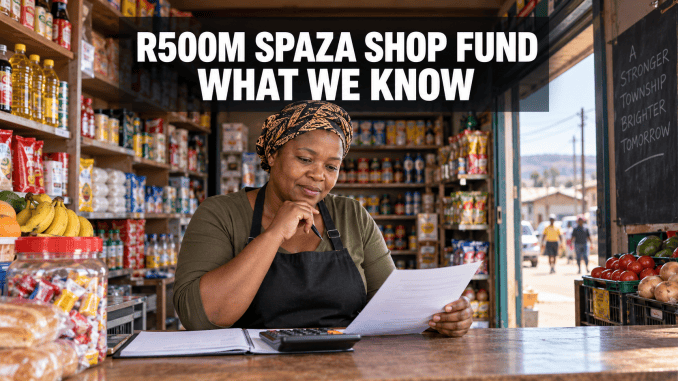
The Spaza Shop Support Fund was introduced as an R500 million lifeline for South African-owned shops in townships and rural communities. More than a year later, the public is asking a very reasonable question: how many spaza shops have actually received support—and where is the rest of the money?
South Africans for Constitutional Reform, better known as SACR, has joined the call for answers. The citizen-led movement has requested information from the Small Enterprise Development Finance Agency, or SEDFA, and created a searchable platform showing the beneficiary information released so far.
This does not mean that R500 million has been stolen or gone missing. There is no verified evidence supporting that conclusion. However, the information presently available does not provide one clear account showing how the entire fund has been allocated, approved and paid.
For many South Africans, asking these questions feels empowering. We have watched years of corruption allegations, failed projects and money intended for communities failing to produce visible change. Citizens are beginning to understand that we do not have to complain quietly in our homes. We can combine our voices, skills and resources to demand truthful answers.
Table of Contents
1. What is the Spaza Shop Support Fund?
The R500 million Spaza Shop Support Fund was formally launched in April 2025. It followed the government’s campaign to register spaza shops after serious food-safety concerns and cases of foodborne illness.
The fund is led by the Department of Small Business Development and the Department of Trade, Industry and Competition. Two public agencies administer different parts of the money:
| Institution | Allocation |
|---|---|
| SEDFA | R150 million |
| National Empowerment Fund | R350 million |
| Total | R500 million |
The purpose is not simply to deposit cash into owners’ personal bank accounts. Depending on the approved package, support may include:
- Stock for the business.
- Shelving, refrigerators and security improvements.
- Point-of-sale equipment.
- Business and financial-management training.
- Assistance with food safety and legal compliance.
- A combination of grant and loan funding.
The current official Spaza Shop Support Fund website describes support of up to R100,000, including a R40,000 stock grant, a blended grant-and-loan component and non-financial business support.
2. How much has been approved and paid?
This is where the numbers can easily confuse the public.
In May 2026, the government reported that 2,369 businesses had been approved for approximately R179.6 million:
- SEDFA approved 1,316 applications valued at R79.6 million.
- The National Empowerment Fund approved 1,053 businesses valued at R99.9 million.
These figures combined both funding agencies. They represented approvals—not necessarily completed payments. The government’s May 2026 statement provides the breakdown.
The next parliamentary update, covering SEDFA’s position at 31 July 2026, reported:
- 5,327 complete applications received.
- 5,064 applications assessed.
- 1,386 applications approved.
- R83.9 million in support approved.
- 1,026 spaza shops given training and point-of-sale devices.
- 930 disbursements completed, worth approximately R57 million.
The lower number of 1,386 does not mean that hundreds of approved businesses disappeared. The earlier figure of 2,369 combined SEDFA and the NEF, while the July figures focused on SEDFA’s stream.
In simple terms:
- Application means someone asked for assistance.
- Approval means the application passed an assessment.
- Disbursement means money or business support was actually delivered.
An approved business is therefore not automatically a paid business.
According to the Parliamentary Monitoring Group’s August briefing, SEDFA had paid or delivered approximately R57 million in support to 930 shops by 31 July 2026.
What remains difficult to find is an equally clear, current account of all payments made through the separate R350 million NEF stream.
3. What does “Spaza Shop Fund due diligence” mean?
“Spaza Shop Fund due diligence” may sound like complicated financial language, but its meaning is simple.
Due diligence means checking that an applicant and business are genuine before public money is released.
Officials may check:
- Whether the owner is a qualifying South African citizen.
- Whether the shop exists and is trading.
- Whether the named applicant genuinely operates the business.
- Whether the shop has a valid municipal permit.
- Whether ownership documents are accurate.
- Whether the same business applied more than once.
- Whether the money will be used for an approved purpose.
This checking process is important because investigators found instances of fronting and ownership mismatches in the wider spaza-shop registration system. In some cases, South Africans were reportedly listed as owners while foreign nationals operated the businesses.
That led to allegations that funding may have reached foreign-operated shops. However, the government told Parliament that suspicious applications had been stopped before payment and that none of the 930 SEDFA disbursements had gone to a foreign-owned shop.
That remains the government’s official position. It should not be presented as independently proven until the complete payment and verification records can be matched. However, the allegation must also not be reported as fact without evidence. Parliament’s 14 August statement explains the controls the government says it applied.
Due diligence protects public money, but it can also delay innocent applicants. The government said only 62% of applicants in the July update were connected to valid municipal licences or temporary permits. Municipal backlogs, slow inspections and difficult zoning requirements can leave genuine shop owners unable to complete their applications.
5. What is SACR investigating?
SACR’s investigation focuses on whether the public can independently check the fund’s beneficiary, approval and payment records.
Its information request initially produced a detailed schedule containing only 162 beneficiary profiles worth R9.784 million. A larger schedule was subsequently made available containing:
- 1,386 approval rows.
- Approximately R83.95 million in approved packages.
- 1,364 normalised unique names.
- Six groups in which all disclosed details were repeated.
Repeated rows do not prove that duplicate payments were made. SACR’s associated FixSA project acknowledges this limitation. The repetitions could be data-entry errors, multiple applications or another administrative issue. Unique application numbers and payment records are needed to resolve them.
The SACR Spaza Shop Fund Atlas allows the public to search the 1,386 disclosed approval rows. Its central argument is fair: a list of approvals is useful, but it is not the same as proof that support was delivered.
The fund can become properly auditable if SEDFA publishes non-sensitive information such as:
- A unique reference number for every application.
- The verified business name and registration number.
- The amount approved.
- The type of support approved.
- The date stock, equipment or money was delivered.
- The payment status.
- Reasons for corrected or repeated entries.
Private identity numbers, banking details and home addresses should remain protected.
You May Also Be Interested In: 5 Reasons Why The Township Economy Is Weakening
6. Where does the enquiry stand now—and what happens next?
SACR’s Spaza Shop Support Fund enquiry is still ongoing. Its work has helped bring a list of 1,386 SEDFA approvals worth approximately R83.9 million into public view. However, the list records approvals—not proof that every shop received money, stock or equipment. The government reported that R57 million had been disbursed to 930 shops by 31 July 2026.
The next step is for SEDFA and the National Empowerment Fund to publish a simple account showing how much of the full R500 million has been paid, which businesses received support and how much remains. According to the Parliamentary Monitoring Group’s record of the 12 August 2026 briefing, the Department of Small Business Development identified accelerating approvals and disbursements, addressing municipal licensing delays and strengthening the tracking of deliveries as immediate priorities. SACR may continue requesting records and updating its public Spaza Shop Fund Atlas. No date for a new national application round had been officially announced at the time of publication.
7. What does this mean for spaza shops and the public?
For spaza shop owners, the investigation could lead to clearer application tracking, faster communication and a fairer funding process. It may also expose weaknesses that prevent genuine businesses from qualifying—especially municipal licensing delays.
For communities, successful funding could mean:
- Better-stocked local shops.
- Safer food-handling practices.
- More competitive prices.
- Improved refrigeration and storage.
- New employment opportunities.
- More money circulating within township economies.
However, these benefits only happen when funding moves beyond announcements and reaches operating businesses.
South Africans are tired of initiatives that sound impressive at launch but become difficult to trace later. After many years of corruption and misuse of public resources, every grant and business-support programme must now work harder for the people it was created to serve.
The current evidence does not show that the remaining Spaza Shop Support Fund money was stolen. It shows that government still owes the public a simpler, consolidated explanation of what was allocated, what was approved, what was delivered and what remains.
Citizens demanding those answers is not negativity. It is democracy.
SACR’s work shows how people can combine their voices and resources to challenge unclear systems. That feels empowering. The next test is whether the government provides the complete records—and whether SACR holds itself to the same high standard of openness.
Township businesses do not only need promises. They need funding that can be seen, measured and trusted.
8. Is this South Africa’s only funding enquiry?
No. The Spaza Shop Support Fund is one of several public programmes facing questions about how money was allocated and whether it reached the intended beneficiaries.
One example is the ongoing investigation into the National Student Financial Aid Scheme. In January 2026, the Special Investigating Unit reported that it had returned more than R1.7 billion in unallocated funds to NSFAS. The money had been held by educational institutions after it was no longer required for the students concerned. Read the official SIU update on the R1.7 billion returned to NSFAS.
The National Lotteries Commission is another example. During the 2025/26 financial year, it completed 72 forensic investigations and reportedly confirmed 63 allegations involving approximately R241.5 million in irregularities. Several cases involved grants intended for community facilities and development projects. Parliament has called for the outstanding NLC cases to be finalised.
There has also been an investigation into COVID-19 Temporary Employer/Employee Relief Scheme payments, commonly known as TERS, after funds meant to protect workers were allegedly claimed fraudulently or paid incorrectly.
These cases do not mean every government fund is corrupt. They show why strong due diligence, public beneficiary records and regular financial reporting are necessary. For citizens, SACR’s Spaza Shop Fund enquiry forms part of a wider national effort to ensure that funding announced in the name of ordinary South Africans genuinely reaches them.
9. What happens to Spaza Shop Support Fund money that is not used?
The short answer is that unused government money does not automatically become free money for officials to spend however they want.
Its treatment depends on where the money is held, how it was transferred and whether it was committed to approved applicants.
Under National Treasury rules, unspent departmental money may only be moved into a later financial year if a rollover is properly requested and approved. Money allocated as a transfer cannot be rolled over for an unrelated purpose.
If a rollover is not approved, unspent departmental funding may have to be surrendered through the government’s financial system. If money was already transferred to a public entity such as SEDFA or the NEF, its treatment will depend on the transfer agreement, approved programme and applicable accounting rules.
In practical terms, the remaining Spaza Shop Support Fund allocation could be:
- Reserved for applications still being processed.
- Committed to businesses that have been approved but not yet assisted.
- Rolled into another financial year for the same programme, if approved.
- Returned or surrendered where it cannot legally be carried forward.
- Reallocated through a lawful budget process.
We do not yet have a public reconciliation explaining which of these categories applies to every remaining rand.
That is why government should publish a simple financial statement showing:
R500 million allocated, minus approvals, minus completed payments, minus programme costs, leaving the confirmed available balance.
As ordinary citizens, we should not have to be accountants to understand where public money stands.
10. Are applications still open, and can spaza shops apply?
Yes. At the time of publication, the official Spaza Shop Support Fund website continued to accept applications, and government was encouraging qualifying spaza shop owners to apply. No separate closing date or next national application period had been officially announced.
The programme currently offers qualifying businesses support of up to R100,000, which may include:
- A grant for purchasing stock.
- A blended grant-and-loan component for shop improvements.
- Business training and other non-financial support.
- Assistance with equipment and point-of-sale systems.
Applicants generally need to operate a South African-owned spaza shop or community convenience store in a township or rural area. They must also meet ownership, municipal licensing, business registration and food-safety requirements.
Applications can be submitted through the official Spaza Shop Support Fund website. Shop owners can also call 011 305 8080 or email spazafund@nefcorp.co.za for assistance.
Requirements and application arrangements may change. Applicants should therefore confirm the latest information on the official portal and should never pay an individual who promises guaranteed approval.
11. Final thoughts
The Spaza Shop Support Fund could help strengthen local businesses, create jobs and keep more money circulating within township communities. For that promise to become reality, every rand must be clearly accounted for and reach genuine beneficiaries.
SACR’s enquiry shows that ordinary citizens can work together to ask important questions. However, accountability must apply equally to government and the organisations demanding answers. Transparency builds trust—and public funding must ultimately work for the people it was created to serve.
12. Frequently asked questions
How many spaza shops have received funding?
By 31 July 2026, SEDFA reported completing 930 disbursements worth approximately R57 million. It had approved 1,386 applications valued at about R83.9 million. Approval does not necessarily mean that funding, stock or equipment has already been delivered.
What happens to unused Spaza Shop Support Fund money?
Unused funding must remain properly accounted for. Depending on its status and applicable Treasury rules, it may be reserved for pending applications, rolled over for the same approved purpose, or surrendered if it cannot be carried forward. The government has not yet published a simple, consolidated statement explaining the remaining balance across both SEDFA and the National Empowerment Fund.
Is funding available for spaza shops in 2026?
Yes. Qualifying South African-owned spaza shops can still apply for financial and business support through the Spaza Shop Support Fund. The official application portal remained available at the time of publication, although funding is subject to eligibility checks and available programme resources.
How much does it cost to register a spaza shop?
There is no single national fee. Spaza shops must register or obtain a trading licence from their local municipality, and each municipality sets its own charges. For example, eThekwini previously listed an R287 fee for a new emerging-business licence, while some municipalities offered free registration. Separately, registering a private company with CIPC generally costs from R125. Applicants should confirm current fees directly with their municipality and CIPC.
Who qualifies for SEFA funding?
SEFA has been incorporated into the Small Enterprise Development Finance Agency, or SEDFA. Requirements depend on the particular funding programme. For the Spaza Shop Support Fund, the shop must generally be South African-owned, operate in a township or rural area, be registered with the municipality and comply with relevant tax, licensing, food-safety and business requirements. The owner must actively manage the shop. Check the official eligibility criteria
Leave a Reply