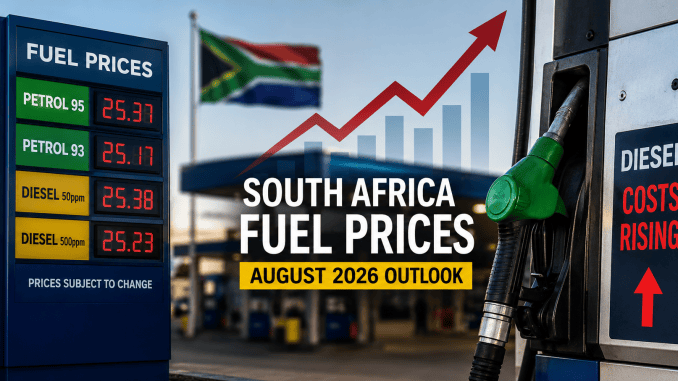
South Africa fuel prices are heading towards another uneven adjustment in August 2026, with petrol motorists still in line for some relief while diesel users face the growing possibility of a price increase.
At the beginning of the fuel-price review period, the outlook appeared far more encouraging. Petrol and diesel were both building substantial over-recoveries, raising hopes that the country could receive meaningful reductions after months of unusually high fuel costs. That picture has changed rapidly.
While the latest outlook suggests petrol prices may still decline slightly, South Africans are continuing to feel the impact of earlier fuel hikes. Our previous report on the fuel price increase in South Africa explains how those increases affected motorists, businesses and household budgets, providing useful context for the latest developments.
Renewed fighting between the United States and Iran, reduced tanker traffic through the Strait of Hormuz and fresh threats to shipping in the Red Sea have pushed international oil prices sharply higher. Brent crude climbed to approximately $92.85 per barrel on 22 July, its highest level in nearly six weeks.
The latest market movement has wiped out diesel’s earlier over-recovery and steadily reduced the petrol relief expected in August. Instead of receiving the large decreases initially projected, motorists may now see petrol fall by less than R1 per litre while some grades of diesel increase.
Although the final adjustment has not yet been confirmed, the changing figures offer an important warning: South Africa remains highly exposed to international oil shocks, even when the rand is relatively stable.
Table of Contents
1. The August Fuel-Price Outlook Has Changed Dramatically
The scale of the reversal can be seen in the movement of the Central Energy Fund’s fuel-price recoveries during July.
At the beginning of the review period, both grades of petrol were showing over-recoveries of approximately R2.50 per litre. Diesel looked even more promising, with an over-recovery of R3.07 per litre for 500ppm diesel and R3.51 per litre for 50ppm diesel.
An over-recovery generally points to a decrease in the following month’s regulated fuel price, provided other parts of the calculation remain unchanged.
However, those favourable positions have been steadily eroded.
The latest figures indicate that petrol’s projected reductions have fallen below R1 per litre, while both grades of diesel have moved into under-recovery territory.
| Fuel | Starting recovery | Current recovery | Change during review period |
|---|---|---|---|
| Petrol 93 | R2.50 over-recovery | R0.83 over-recovery | -R1.67 |
| Petrol 95 | R2.50 over-recovery | R0.79 over-recovery | -R1.71 |
| Diesel 500ppm | R3.07 over-recovery | R0.45 under-recovery | -R3.52 |
| Diesel 50ppm | R3.51 over-recovery | R0.22 under-recovery | -R3.73 |
| Illuminating paraffin | R3.43 over-recovery | R0.21 under-recovery | -R3.64 |
The difference between the starting and current positions shows how quickly international energy-market conditions can alter South Africa’s monthly fuel forecast.
2. Diesel Has Moved From a Large Saving to a Possible Increase
Diesel has experienced the sharpest deterioration.
Current projections point to possible increases of:
- 45 cents per litre for 500ppm diesel
- 22 cents per litre for 50ppm diesel
- 21 cents per litre for illuminating paraffin
These figures remain unaudited and could change before the review period closes. Nevertheless, they represent a major reversal from the reductions of more than R3 per litre that appeared possible earlier in the month.
The diesel outlook has been hit by more than the rising price of crude oil.
International diesel markets have also faced pressure from reduced Russian fuel exports and concerns about refinery supply. Diesel and petrol do not always move by identical amounts because South Africa’s calculation tracks the international prices of the refined products rather than crude oil alone.
This helps explain why petrol can remain in over-recovery while diesel has already moved into the red.
The distinction is important for motorists deciding whether the petrol forecast offers a complete picture of the country’s fuel situation. A petrol decrease may provide some household relief, but a diesel increase can still raise the cost of transporting food, building materials and other goods.
3. Petrol Motorists May Still Receive Limited Relief
Petrol remains on course for a decrease, although the expected relief is considerably smaller than it was at the start of the review period.
The latest recovery figures point to approximate decreases of:
- 83 cents per litre for Petrol 93
- 79 cents per litre for Petrol 95
Earlier projections had suggested decreases of more than R3 per litre. By 17 July, the expected reduction had already fallen to about 95 cents for petrol 93 and 90 cents for petrol 95. The subsequent deterioration reduced those estimates even further.
For a motorist filling a 50-litre petrol tank, a decrease of 79 cents per litre would produce a saving of about R39.50 per tank.
That is still welcome relief, but it is far below the saving of more than R180 that motorists might have received if the earlier R3.60-plus projections had held.
The petrol outlook could also weaken further if oil remains above $90 per barrel or the rand loses ground against the US dollar during the remaining calculation days.
4. Global Conflict Is Driving the Sudden Reversal
The main pressure on the current fuel-price forecast is the renewed conflict involving the United States and Iran.
Oil prices had eased during the earlier ceasefire period. Brent crude was trading around $72 per barrel in late June, helping South Africa accumulate large fuel-price over-recoveries.
Once hostilities resumed, concerns about oil production and shipping routes returned.
By 17 July, Brent had climbed to approximately $88 per barrel. On 22 July, it rose further to around $92.85, an increase of approximately 29% from the late-June level.
The market has been responding to several connected risks:
- US strikes on Iranian military targets have continued.
- Iran has retaliated against American facilities and regional allies.
- Tanker traffic through the Strait of Hormuz has fallen sharply.
- Iran-aligned Houthi forces have threatened vessels carrying Saudi oil.
- Some tankers have changed course to avoid higher-risk shipping routes.
- Disruptions elsewhere, including the Black Sea, have added to global supply uncertainty.
The Strait of Hormuz is one of the world’s most important energy routes. When traffic through the waterway is threatened, markets react not only to the amount of oil immediately lost but also to the possibility of wider and longer-lasting disruption.
Alternative routes may add time, insurance costs and transport expenses, all of which can increase the international price of petroleum products.
5. Higher Diesel Costs Could Affect More Than Motorists
A possible diesel increase matters even to South Africans who do not own diesel vehicles.
Diesel powers a significant portion of the country’s commercial economy, including:
- Long-distance freight trucks carrying food and consumer products
- Agricultural machinery used in planting and harvesting
- Mining and construction equipment
- Delivery vehicles and logistics fleets
- Backup generators used by businesses and public facilities
- Some taxis, buses and other public transport vehicles
When the wholesale diesel price rises, companies may initially absorb part of the increase. If costs remain elevated, however, they can eventually be passed through to customers.
A sustained increase can, therefore, influence the following:
- Food distribution costs
- Retail prices
- Public transport expenses
- Construction costs
- Farming input costs
- Online shopping and delivery charges
- Overall consumer inflation
The effect is rarely immediate or equal across every industry, but diesel is deeply embedded in the movement and production of goods throughout South Africa.
This is why economists and policymakers pay close attention to fuel-price movements beyond their direct effect on motorists.
6. How South Africa Calculates Its Monthly Fuel Prices
South Africa’s petrol and diesel prices are adjusted monthly using a regulated pricing system.
The calculation is influenced mainly by two changing external factors:
International petroleum product prices
South Africa imports a large share of the crude oil and refined fuel it consumes. The international prices of petrol, diesel and other petroleum products therefore form an important part of the local price.
When international product prices rise above the level used in the current regulated price, an under-recovery develops. When they fall below that level, an over-recovery develops.
The rand-dollar exchange rate
International oil and refined petroleum products are generally priced in US dollars.
A weaker rand makes imports more expensive, even when the international dollar price is unchanged. A stronger rand can help cushion the effect of rising oil prices.
The final pump price also contains relatively stable domestic components, including taxes, levies, transport costs, wholesale margins and retail margins.
The CEF publishes daily basic fuel-price data to show how international product prices and the exchange rate are affecting the developing monthly adjustment. These figures are useful projections, but they are not the official final changes.
The official adjustment is announced by the Department of Mineral and Petroleum Resources after the review period has closed.
7. Estimated Petrol and Diesel Prices for August
Based on the latest recovery estimates, the following prices could apply if the current projections remain unchanged.
Estimated inland prices
| Fuel | July 2026 price | Projected change | Estimated August price |
| Petrol 95 | R26.10 | -R0.79 | R25.31 |
| Petrol 93 | R25.94 | -R0.83 | R25.11 |
| Diesel, 50ppm, wholesale | R25.16 | +R0.22 | R25.38 |
| Diesel 500ppm wholesale | R24.78 | +R0.45 | R25.23 |
Estimated coastal prices
| Fuel | July 2026 price | Projected change | Estimated August price |
| Petrol 95 | R25.23 | -R0.79 | R24.44 |
| Petrol 93 | R25.15 | -R0.83 | R24.32 |
| Diesel, 50ppm, wholesale | R24.41 | +R0.22 | R24.63 |
| Diesel 500ppm wholesale | R23.91 | +R0.45 | R24.36 |
These are simplified estimates calculated by applying the current recoveries to July’s listed prices.
Diesel prices are quoted at the wholesale level. The amount paid at a service station may differ because the retail price of diesel is not regulated in the same way as the petrol pump price.
8. What Motorists Should Watch Before the Final Announcement
The current forecast should be treated as a strong indication rather than a confirmed result.
Several developments could still affect South Africa’s fuel prices before the August adjustment is finalised.
Brent crude oil
Oil has already risen beyond the levels used in the earlier projections. If Brent remains above $90 or increases further, diesel’s under-recovery could deepen and petrol’s expected reduction could shrink.
The rand-dollar exchange rate
A stronger rand could offset part of the oil-price pressure. A weaker rand would make imported fuel more expensive and worsen the outlook.
Shipping through key energy routes
Any credible ceasefire, reopening of shipping routes or reduction in attacks could calm oil markets. Further disruption to the Strait of Hormuz, Red Sea or other export routes could have the opposite effect.
International refined-product shortages
Diesel can face separate pressure when refineries or major exporters reduce supply. This means diesel may continue performing worse than petrol even if crude oil prices stabilise.
The end-of-month CEF calculation
Daily recovery figures fluctuate. The final adjustment will depend on the average position across the full review period, not only the figure recorded on one day.
Fuel costs may also feature in the South African Reserve Bank’s assessment of inflation.
9. South Africa Fuel Prices and the Interest-Rate Debate
The Monetary Policy Committee is scheduled to announce its next interest-rate decision on 23 July 2026. The SARB confirms that monetary-policy statements are released following each MPC meeting, with further announcements scheduled for September and November.
Higher oil and fuel prices can complicate the inflation outlook by raising transport and production costs. However, the Reserve Bank considers a broad range of information, and a fuel-price increase alone does not automatically determine the interest-rate decision.
The central bank will also consider underlying inflation, economic growth, consumer demand, wage developments, the exchange rate and inflation expectations.
For households, the combination of expensive fuel and high borrowing costs would be particularly difficult. Petrol may fall modestly in August, but diesel-driven supply-chain costs could limit the broader benefit.
Final Outlook
The August picture is not entirely negative. Petrol motorists are still likely to receive a decrease if the current over-recoveries survive the remainder of the review period.
The larger concern is how quickly diesel has moved from a projected reduction of more than R3 per litre to a possible increase.
That reversal shows how vulnerable South Africa’s fuel prices remain to developments in global energy markets. A conflict thousands of kilometres away can raise local transport costs, affect food distribution, influence inflation, and place fresh pressure on household budgets.
Frequently Asked Questions
Will petrol become cheaper in August 2026?
Current CEF recovery estimates point to decreases of approximately 83 cents per litre for petrol 93 and 79 cents per litre for petrol 95. The final changes have not yet been confirmed.
Is diesel expected to increase?
Current projections indicate possible increases of approximately 45 cents per litre for 500ppm diesel and 22 cents per litre for 50ppm diesel.
Why did the fuel-price forecast change?
The outlook deteriorated mainly because international oil and refined-product prices increased sharply after renewed conflict and shipping disruptions in the Middle East.
When will the official August fuel prices be announced?
The Department of Mineral and Petroleum Resources normally confirms the official adjustment near the end of the review period, before the new prices take effect in the first week of the following month.
Are the CEF figures final?
No. Daily CEF recoveries are unaudited estimates. They show the developing outlook but can change before the official adjustment is calculated.
Leave a Reply