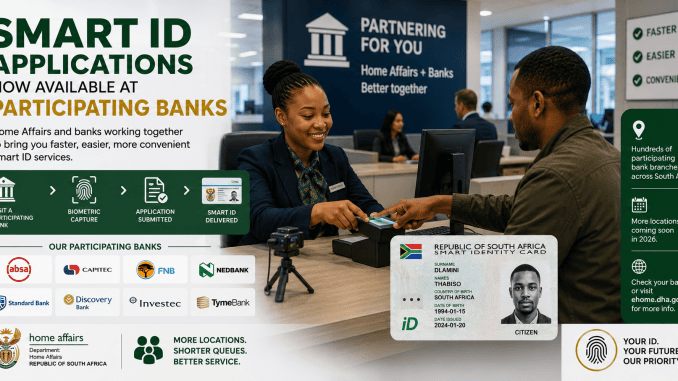
Smart ID applications have become much easier for many South Africans over the past year, thanks to one of the Department of Home Affairs’ biggest digital transformation programmes in recent memory.
For decades, many citizens associated Home Affairs with crowded waiting rooms, long queues, repeated visits and frustrating delays. Whether replacing a lost identity document, collecting a Smart ID card or applying for a passport, visiting a Home Affairs office often meant setting aside an entire day.
While those challenges have not disappeared completely, the department is gradually changing how it delivers services. Through partnerships with banks, greater use of digital technology and improved automation, Home Affairs is reducing pressure on its offices while giving South Africans more convenient ways to access essential identity services.
More than 422,000 applications have already been processed through participating bank branches, and the department plans to expand these services even further before the end of 2026. Although there is still room for improvement, these developments suggest that obtaining a Smart ID may become significantly easier for millions of South Africans in the years ahead.
Table of Contents
1. Smart ID Services Are No Longer Limited to Home Affairs Offices
One of the biggest frustrations for many South Africans has always been travelling to a Home Affairs office, only to find long queues or system interruptions.
That experience is beginning to change.
Instead of relying solely on government offices, Home Affairs has expanded its partnership with participating banks, allowing eligible applicants to complete biometric verification and submit Smart ID applications at selected branches.
This expansion has dramatically increased the number of locations where citizens can access certain Home Affairs services.
For people living near participating bank branches, this means less travelling, shorter queues and a more convenient application process.
The initiative also reduces pressure on traditional home affairs offices, allowing officials to focus on services that still require in-person assistance.
2. Hundreds of Thousands of South Africans Are Already Using the New System
The growth of the Smart ID programme has been much faster than many expected.
In only a few months, more than 422,000 applications have already been processed through participating banks.
Perhaps even more impressive is that this increase was achieved without increasing the department’s overall budget or employing thousands of additional staff members.
Instead, improvements have largely come from making better use of technology.
Digital processing allows applications to move through the system more efficiently while reducing paperwork and manual administration.
For citizens, this often means spending less time waiting and more confidence that applications are progressing through the system.
3. More Bank Branches Will Soon Offer Smart ID Services
The current rollout is only the beginning.
Home Affairs intends to expand the programme to approximately 750 participating bank branches by the end of 2026.
As the network grows, more South Africans should be able to apply closer to home rather than travelling to one of the department’s regional offices.
The department has also indicated that additional services are expected to become available through participating banks, including:
- First-time Smart ID applications
- Passport applications
- Passport renewals
- Additional biometric services
If these plans are successfully implemented, visiting a Home Affairs office may eventually become necessary only for specialised services.
4. Digital Technology Is Speeding Up Applications
Technology is playing an increasingly important role in the department’s modernisation programme.
Instead of depending entirely on paper-based processes, Home Affairs has been introducing digital systems that automate parts of the application process.
Digital biometric capture, electronic verification and integrated systems reduce duplication while helping officials process higher volumes of applications.
Automation also creates electronic records of decisions, making applications easier to track.
Although occasional system downtime remains a challenge, the department believes digital services will continue improving turnaround times as more systems come online.
For applicants, that could mean fewer repeat visits and faster processing.
5. Smart ID Is Becoming More Important Than Ever
The Smart ID card offers several advantages over the older green barcoded identity book.
Besides being more durable, the card includes stronger security features designed to reduce identity fraud.
It also supports South Africa’s long-term vision of expanding secure digital government services.
As more public and private organisations move towards electronic verification, the Smart ID card is expected to become increasingly useful when accessing banking services, government programmes and other official transactions.
While the green ID book remains legally valid, many South Africans are choosing to upgrade to benefit from the newer technology.
6. Home Affairs Is Using Technology to Improve Transparency
Digital transformation is not only about convenience.
It also plays an important role in strengthening accountability.
Historically, paper-based processes created opportunities for missing documents, inconsistent decision-making and, in some cases, corruption.
By introducing automated workflows and electronic audit trails, Home Affairs hopes to reduce unnecessary human intervention in routine applications.
The department has also intensified disciplinary action against officials implicated in corruption and maladministration while strengthening oversight across several services.
Although technology alone cannot eliminate corruption, greater automation makes it more difficult for applications to be manipulated without leaving a digital record.
What do these changes mean for South Africans?
For ordinary South Africans, these reforms could save both time and money.
Instead of taking leave from work to spend an entire day at Home Affairs, more people may eventually complete their applications through participating banks closer to where they live or work and through their online portal.
The improvements could also benefit businesses by making identity verification and document replacement more efficient.
However, expectations should remain realistic.
Not every service is currently available through every participating bank, and some Home Affairs offices still experience infrastructure challenges, staffing shortages and system downtime.
The modernisation programme is therefore best viewed as an ongoing journey rather than a completed project.
Looking Ahead
Home Affairs has set itself an ambitious goal of becoming a digitally enabled government department capable of delivering faster, more reliable services to millions of South Africans.
The expansion of Smart ID services represents one of the clearest examples of that ambition becoming visible to the public.
If the department successfully expands its banking partnerships, introduces additional online services and continues reducing administrative delays, applying for a Smart ID could become a far simpler experience than many South Africans have come to expect.
While there is still considerable work ahead, the progress made during the past year suggests that Home Affairs is moving steadily towards a more modern, accessible and efficient future.
For citizens planning to replace an identity document or apply for a Smart ID in the coming months, keeping an eye on newly participating bank branches and digital services could make the process faster and considerably more convenient than in previous years.
Frequently Asked Questions
What is a Smart ID card?
A Smart ID card is South Africa’s modern identity document that replaces the older green barcoded ID book. It contains advanced security features and biometric information to help protect against identity fraud. The card is accepted as official proof of identity throughout South Africa.
How much does a Smart ID cost?
The cost depends on the type of application:
- First Smart ID card (for South African citizens aged 16 years and older): Free
- Replacement or reissued Smart ID card: R140
- Temporary Identity Certificate (if required): R70
Applicants should always confirm the latest fees with the Department of Home Affairs before applying, as government fees can change.
Which banks offer Home Affairs Smart ID services?
Home Affairs currently partners with selected branches of several major South African banks to provide Smart ID and other identity services. These include:
- Absa
- Capitec Bank
- Discovery Bank
- First National Bank (FNB)
- Investec
- Nedbank
- Standard Bank
Only selected branches offer Home Affairs services, so it’s important to check whether your nearest branch participates before making an appointment or visiting.
Can I still use my green ID book?
Yes. The green barcoded ID book remains a valid form of identification in South Africa. However, Home Affairs encourages eligible citizens to upgrade to the Smart ID card because it offers better security and supports the country’s move towards more digital government services.
How long does it take to get a Smart ID card?
Processing times can vary depending on application volumes and operational factors. While biometric capture at many participating bank branches is often completed quickly, the time it takes to receive your Smart ID card may differ from one application to another. Applicants are notified once their card is ready for collection.
What documents do I need to apply for a Smart ID?
Specific documentation varies based on your application type:
Proof of residence (e.g., a recent utility bill or bank statement in your or your parent’s name)
First-Time Applicants (16 years and older):
Original and certified copy of your Birth Certificate
Certified copy of your parent’s or legal guardian’s ID (Smart ID or green ID book)
Replacing a Green ID Book or Card:
- Your current green ID book or existing Smart ID
- Proof of residence
Lost, Stolen, or Damaged IDs:
- Proof of residence
- A sworn affidavit from a police station detailing the circumstances of the lost or stolen ID
Leave a Reply