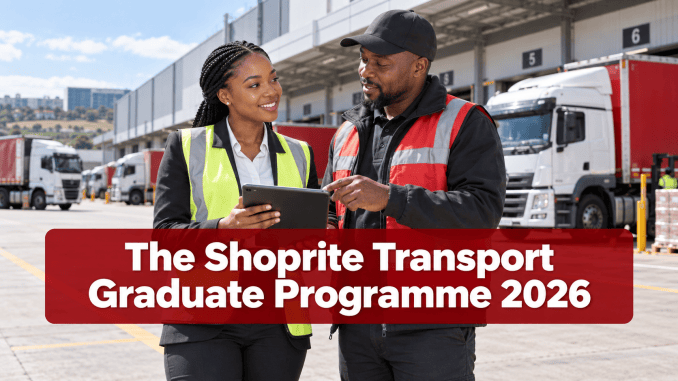
The Transport Graduate Programme in Centurion offers graduates an opportunity to gain practical exposure across several transport functions while developing operational, analytical and leadership skills. This full-time programme is based in Gauteng and is intended for candidates with a relevant commerce, logistics, transport or supply chain qualification.
Unlike a position that focuses on only one task from the beginning, the programme allows trainees to rotate through different departments and functions. This gives participants a broader understanding of how transport operations work from end to end, including fleet management, operational processing, customer service, compliance and continuous improvement.
Applications close on 30 September 2026. Candidates should carefully review the qualification and experience requirements before submitting an application under reference number SHO260918-3. See section 7 below to apply.
Table of Contents
1. Transport Graduate Programme Overview
The Transport Graduate Programme is structured to introduce trainees to the different activities that support an effective transport operation. Graduates will be integrated into the business and given practical exposure intended to build the knowledge and confidence needed for future responsibilities.
The main vacancy details are:
| Vacancy information | Details |
| Job title | Transport Graduate Programme |
| Reference number | SHO260918-3 |
| Employment type | Full-time |
| Job category | Transportation |
| Location | Centurion, Gauteng, South Africa |
| Closing date | 30 September 2026 |
The rotational nature of the programme is one of its most useful features. Instead of learning about transport only through theory, trainees can observe how departments work together to move goods or services safely, efficiently and on schedule.
2. What Successful Graduates Will Do
Participants will rotate through different transport departments or functions to develop an end-to-end understanding of operations. The work will combine practical learning, data analysis, teamwork and exposure to business projects.
Core responsibilities include:
- Learning transport operations: Graduates will observe and participate in different functions to understand how individual processes connect.
- Supporting fleet management: Trainees will learn and apply accepted practices used to coordinate vehicles and related operational activities.
- Reviewing operational data: Graduates will analyse information and identify opportunities to improve efficiency, productivity and service levels.
- Joining improvement projects: Participants will contribute to continuous-improvement initiatives and other business projects.
- Working across departments: The position requires collaboration with cross-functional teams that support operational and strategic objectives.
- Developing leadership ability: Coaching, mentoring and practical management exposure will help trainees strengthen their decision-making and leadership skills.
- Monitoring standards: Graduates will assist with compliance relating to health and safety, quality and operational requirements.
- Supporting customer service: Efficient transport operations play an important role in delivering a reliable experience to customers.
- Building stakeholder relationships: Trainees will engage with people across the business and learn how to maintain productive working relationships.
- Contributing new ideas: Graduates will be expected to think constructively and suggest improvements that support operational excellence.
These duties show that the programme is not limited to observation. Successful applicants should be prepared to participate actively, learn from feedback and take responsibility for assigned tasks.
3. Qualifications and Experience Required
Applicants should hold a relevant qualification such as:
- BCom in Logistics Management.
- Transport Management.
- Transport Economics.
- Supply Chain Management.
- Another closely related qualification.
Candidates should also have one to two years of experience in a transport or logistics environment. This experience could help applicants understand common operational processes and adapt more quickly to the programme’s practical requirements.
Before applying, candidates should check that the name and level of their qualification are accurately reflected on their CV. If the qualification has a different title, the applicant should make its relevance to transport, logistics or supply chain work clear without misrepresenting it.
4. Important Knowledge and Workplace Skills
The Transport Graduate Programme requires more than academic knowledge. Participants will work with operational information, deadlines, colleagues and stakeholders, making communication and organisation particularly important.
The advertised job-related skills include:
- Interpersonal skills: Graduates must be able to work respectfully and productively with people in different roles.
- Communication: Clear verbal and written communication supports accurate reporting, teamwork and stakeholder engagement.
- Computer literacy: Candidates should be comfortable using common computer systems and workplace applications.
- Business analysis methodology: The ability to assess processes and information will help graduates identify operational problems and possible improvements.
- Planning and organising: Transport activities depend on coordination, accurate scheduling and attention to detail.
Applicants can strengthen their CVs by giving short, factual examples of when they used these skills. Relevant examples may come from employment, internships, workplace projects, university assignments or recognised volunteer activities.
5. Competencies the Programme Will Assess
The programme identifies several broad competencies that describe how candidates are expected to approach their work.
These include:
- Leading and deciding: Taking responsibility and making sound decisions when appropriate.
- Supporting and coordinating: Helping colleagues and ensuring that activities are properly aligned.
- Interacting and presenting: Communicating ideas clearly and working confidently with others.
- Analysing and interpreting: Reviewing information carefully and drawing practical conclusions.
- Creating and conceptualising: Thinking of new approaches and understanding broader business needs.
- Organising and executing: Turning plans into accurate, timely action.
- Adapting and coping: Remaining effective when priorities, pressures or working conditions change.
- Enterprising and performing: Showing initiative while remaining focused on measurable results.
Candidates do not need to fill their CVs with these phrases repeatedly. It is more convincing to demonstrate the competencies through real achievements, responsibilities and examples.
6. Career Value of the Graduate Programme
The Transport Graduate Programme can provide a useful bridge between academic learning and day-to-day transport operations. Departmental rotations may help participants understand which area of the industry best matches their strengths and career goals.
Exposure to fleet practices, operational data, safety standards, service delivery and improvement projects can also build a balanced foundation for future roles. Depending on a graduate’s development and later opportunities, relevant career paths may include:
- Transport operations.
- Fleet coordination.
- Logistics analysis.
- Supply chain support.
- Operational supervision.
- Transport planning.
- Continuous-improvement support.
Applicants should, however, treat the programme as a learning and development opportunity rather than assume that it guarantees permanent employment or promotion. The supplied advertisement does not promise a permanent position after completion.
You May Also Be Interested In: Sales Associate Vacancies Available Across South Africa
7. How to Prepare and Apply
Applicants should apply online through the official application platform:
Before submitting an application:
- Update your CV with accurate contact, education and employment details.
- Place your relevant qualification where it can be found easily.
- Describe your one- to two-year transport or logistics experience clearly.
- Highlight experience involving data, fleet activities, planning, customer service or operational improvement.
- Use examples to demonstrate communication, teamwork, analysis and organisation.
- Check that the application refers to the correct vacancy and reference number.
- Submit all required information before 30 September 2026.
- Keep confirmation or a screenshot showing that the application was submitted.
Applicants should avoid claiming skills or experience they do not have. A concise, honest and well-organised application is more credible than one filled with unsupported statements.
8. Frequently Asked Questions
Where is the Transport Graduate Programme based?
The programme is based in Centurion, Gauteng, South Africa.
Is this a full-time opportunity?
Yes. The vacancy is advertised as a full-time Transport Graduate Programme.
What qualifications are accepted?
The advertisement lists BCom Logistics Management, Transport Management, Transport Economics, Supply Chain Management and related qualifications.
Is previous experience required?
Yes. Applicants should have one to two years of experience in a transport or logistics environment.
Leave a Reply