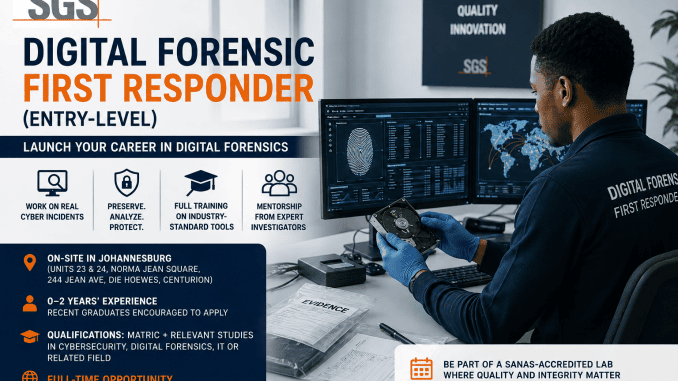
The Digital Forensic First Responder opportunity at SGS offers recent graduates and early-career candidates a chance to gain practical experience in digital forensics, cyber incident response and investigations while receiving structured training.
SGS describes this as a genuine entry-level position requiring 0–2 years of experience, and recent graduates are specifically encouraged to apply. Candidates do not need previous experience using specialist forensic tools such as FTK Imager, Autopsy, Cellebrite or EnCase because training will be provided.
This doesn’t mean that applicants need no technical background. Candidates must have Matric/Grade 12 together with current studies or a completed qualification in Cybersecurity, Digital Forensics, IT or a related field.
For someone who has studied technology and is now looking for an opportunity to turn that knowledge into practical experience, here’s what makes the position worth considering. Please apply in section 8 below.
Table of Contents
1. Digital Forensic First Responder Job Overview
Here are the key details applicants should know:
Position: Digital Forensic First Responder (Entry-Level)
Company: SGS
Employment type: Full-time
Experience: 0–2 years
Education: Grade 12 plus current studies or a completed relevant qualification
Work arrangement: On-site; not a remote position
Advertised address: Units 23 and 24, Norma Jean Square, 244 Jean Avenue, Die Hoewes, Centurion, South Africa
Relevant study fields: Cybersecurity, Digital Forensics, IT or related disciplines
Prior forensic tool experience: Not required
Passport: Valid passport or ability to obtain one within a reasonable timeframe
The job combines practical investigation support with structured learning, making it particularly relevant to candidates beginning a career in digital forensics.
2. Why This Is a Genuine Entry-Level Opportunity
One of the biggest challenges facing graduates is finding vacancies labelled “entry-level” that don’t also demand several years of professional experience.
The SGS opportunity is different in an important way.
The company specifies 0–2 years of experience and explicitly encourages recent graduates to apply. It also states that previous experience with its listed forensic tools is not required.
Successful candidates will instead receive training and work alongside experienced investigators.
That makes the Digital Forensic First Responder position an opportunity for candidates who already have the necessary educational foundation but still need practical industry exposure.
It is important, however, not to confuse entry-level with “no requirements”. Applicants are still expected to understand the basics of computers, operating systems, and file systems and have relevant tertiary studies or qualifications.
3. What You Will Do in the Role
The successful candidate will support digital forensic incident response and investigation activities.
This means the work can involve real cyber incidents, fraud investigations and digital crime scenes under the guidance of more experienced investigators.
Responsibilities include:
- Supporting forensic investigations: You’ll assist experienced team members with digital forensic incident response and investigation activities.
- Handling digital evidence: The role involves helping collect and preserve evidence while maintaining the correct chain of custody.
- Performing basic analysis: Under supervision, you’ll examine information such as logs, files, emails and user activity.
- Identifying potential threats: You’ll learn how to recognise and escalate indicators of compromise, commonly referred to as IOCs.
- Maintaining documentation: Accurate records must be maintained for legal and auditing purposes.
Forensic investigations can potentially have legal consequences, which is why following procedures carefully and documenting work accurately are important parts of the job.
4. Forensic Tools You Could Learn to Use
Another attractive aspect of the opportunity is exposure to specialist technology used in digital investigations.
SGS says successful candidates may work with tools including:
FTK Imager – commonly used when acquiring and examining digital evidence.
Autopsy – a digital forensics platform used to investigate data from computers and storage devices.
Cellebrite – technology associated with digital intelligence and the examination of mobile-device data.
EnCase – forensic software used in digital investigations and evidence examination.
EDR platforms – Endpoint Detection and Response technology used to identify and investigate potentially suspicious activity on devices.
Applicants are not required to already know these tools.
SGS says full, structured training will be provided, allowing the successful candidate to learn the technology and relevant forensic methodology as part of the job.
5. Essential Qualifications and Requirements
Candidates need to meet the minimum requirements before applying for the Digital Forensic First Responder position.
Applicants must have Matric/Grade 12 as well as either be currently studying towards or have completed a qualification in:
- Cybersecurity
- Digital Forensics
- Information Technology
- A related field
Candidates should also have a basic understanding of how computers, operating systems and file systems function.
Because forensic work requires precision, SGS is looking for someone with strong attention to detail who is willing to follow structured procedures exactly.
Professional written and verbal communication in English is also required.
Applicants must be able to work on-site, as SGS specifically states that the position cannot be performed remotely.
The advertisement provides a Centurion address while also referring to an on-site requirement in Johannesburg. Candidates who need clarity on the exact reporting location should confirm this through the recruitment process.
A valid passport or the ability to obtain one within a reasonable timeframe is another requirement because potential client or site travel may be necessary.
6. Advantageous Skills That Are Not Required
SGS separates several additional skills from its essential requirements.
These could strengthen an application, but they are specifically described as advantageous rather than mandatory.
They include:
- Previous IT support experience.
- Security Operations Centre (SOC) experience.
- General cybersecurity experience.
- Knowledge of networking fundamentals.
- Exposure to evidence handling or forensic concepts.
- Entry-level certifications such as Security+ or CHFI.
This distinction matters for graduates.
If you meet the essential requirements but don’t have a cybersecurity certification or previous SOC experience, you shouldn’t automatically exclude yourself solely because you lack one of these advantageous credentials.
7. Training, Mentorship and Career Exposure
The learning opportunities are arguably one of the most important parts of this vacancy.
SGS says it will provide full, structured training on industry-standard forensic tools and methodologies.
The successful candidate can also expect hands-on exposure to real-world cyber investigations from the beginning of their employment.
SGS says the role includes:
- Structured forensic-tool training.
- Practical experience with real investigations.
- Mentorship from experienced investigators.
- Exposure to digital forensic methodology.
- An entry point into a digital forensics career within a SANAS-accredited laboratory.
Working alongside experienced investigators can help bridge the gap between what candidates learn during their studies and how forensic investigations operate in professional environments.
8. How to Apply for the Digital Forensic First Responder Position
Candidates interested in the opportunity should apply through the official recruitment channel provided for the SGS vacancy.
Official Application Portal: Apply Here
You May Also Be Interested In: Hangar Assistant Job in Durban
Before submitting your application, review your CV carefully and make sure your relevant technical education is easy for recruiters to identify.
If you’re still studying, clearly state your qualification, institution and current stage of study. Graduates should include their completed qualification and relevant technical coursework.
You can also highlight university projects, practical assignments, labs or other legitimate experience involving cybersecurity, operating systems, networking or digital forensics.
If you have IT support, SOC or cybersecurity experience, relevant certifications or previous exposure to evidence handling, include these as well.
Most importantly, keep everything accurate. You don’t need to claim experience with FTK Imager, Autopsy, Cellebrite or EnCase if you haven’t used them. SGS has already made it clear that prior experience with these tools is not required.
9. Final Thoughts
For students and recent graduates trying to enter cybersecurity, getting that first opportunity to work on real investigations can be an important career step.
The SGS Digital Forensic First Responder vacancy stands out because it combines a clearly defined entry-level experience requirement with structured training, mentorship and hands-on exposure to real-world digital investigations.
It could be especially relevant for someone who already has the educational foundation in Cybersecurity, Digital Forensics or IT, but hasn’t yet had the opportunity to build substantial professional experience.
The work also comes with serious responsibilities. Digital evidence must be handled carefully, confidentiality respected and procedures followed accurately. SGS specifically highlights integrity, attention to detail, communication, teamwork and the ability to remain calm and methodical under pressure.
For the right candidate, however, this is an opportunity to move beyond theory and begin developing practical digital-forensics experience under the guidance of established investigators.
Leave a Reply