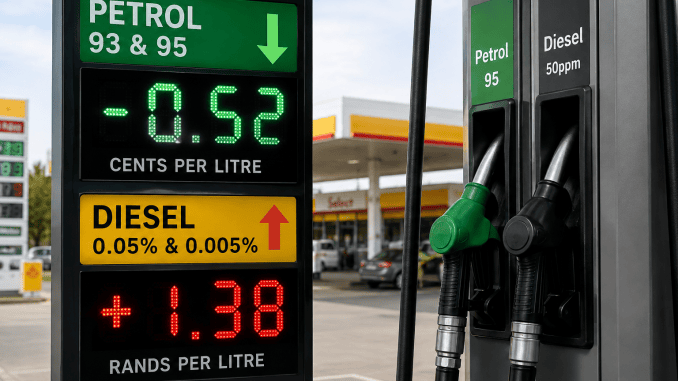
South Africa’s fuel prices will change from Wednesday, 5 August 2026, bringing welcome relief for petrol motorists while increasing costs for many diesel users.
According to the official fuel price media statement released by the Central Energy Fund (CEF) on behalf of the Department of Mineral and Petroleum Resources (DMPR), both grades of petrol will decrease by 52 cents per litre. At the same time, diesel prices will increase by between R1.23 and R1.38 per litre, depending on the grade.
For many South Africans, the immediate question is simple: Why is petrol becoming cheaper while diesel is getting more expensive?
The answer lies in a combination of international fuel prices, the Rand/US dollar exchange rate and an adjustment to South Africa’s fuel pricing system known as the slate levy. Here’s what you need to know.
Table of Contents
1. Official fuel price changes from 5 August 2026
The official fuel price adjustments taking effect on Wednesday, 5 August 2026, are:
- Petrol 93 (ULP & LRP): 52 cents per litre decrease
- Petrol 95 (ULP & LRP): 52 cents per litre decrease
- Diesel 0.05% Sulphur (500 ppm): R1.38 per litre increase
- Diesel 0.005% Sulphur (50 ppm): R1.23 per litre increase
- Illuminating Paraffin (Wholesale): R1.52 per litre increase
- LPGas: R4.41 per kilogram decrease
While petrol motorists will benefit immediately from lower prices at the pump, diesel users will experience noticeably higher fuel costs.
2. How much will motorists save?
Although a saving of 52 cents per litre may not seem significant at first, it can make a noticeable difference over a month.
For example:
- A 40-litre tank will cost approximately R20.80 less.
- A 50-litre tank will cost approximately R26.00 less.
- A 60-litre tank will cost approximately R31.20 less.
For households that rely on petrol-powered vehicles for daily commuting, these savings can help reduce monthly transport expenses.
3. Why are petrol prices falling?
South Africa’s fuel prices are primarily influenced by two external factors:
- International fuel prices.
- The Rand/US Dollar exchange rate.
During the official fuel price review period between 26 June and 30 July 2026, international petrol prices declined. Because South Africa imports much of its refined fuel, lower global petrol prices reduced the Basic Fuel Price (BFP), which is the largest component used to calculate local petrol prices.
This created downward pressure on petrol prices.
However, lower international prices were not the only reason motorists are receiving a larger-than-expected reduction.
The Rand moved in the opposite direction.
During the same review period, the average exchange rate weakened from R16.3774 to R16.4554 against the US Dollar.
A weaker Rand generally makes imported fuel more expensive because petroleum products are bought in US Dollars.
Ordinarily, this would have increased local fuel prices.
Fortunately for petrol motorists, another adjustment more than offset the impact of the weaker currency.
4. Why is diesel becoming more expensive?
While international petrol prices declined, international diesel prices moved in the opposite direction.
According to the CEF, diesel prices increased significantly during the review period, resulting in official increases of:
- R1.38 per litre for Diesel 500 ppm
- R1.23 per litre for Diesel 50 ppm
Although diesel also benefited from the reduction in the slate levy, rising international diesel prices were large enough to outweigh that saving.
This is why petrol and diesel are moving in different directions despite both being adjusted on the same day.
You May Also Be Interested In: 35 Retail Jobs and Learnership Opportunities at Pick n Pay, Woolworths and SPAR.
5. Why are there two diesel prices?
Many motorists are surprised to discover that South Africa has two official diesel prices.
The difference comes down to the amount of sulphur contained in the fuel.
Diesel 0.05% Sulphur (500 ppm)
This grade contains more sulphur and is commonly used in:
- Older diesel vehicles
- Heavy trucks
- Buses
- Tractors
- Construction and mining equipment
Diesel 0.005% Sulphur (50 ppm)
This cleaner diesel contains ten times less sulphur and is typically used in:
- Modern diesel cars
- Newer bakkies
- SUVs
- Vehicles fitted with advanced emissions systems
Because these are different fuel products traded on international markets, their prices can increase or decrease by different amounts.
6. What is the slate levy?
One of the biggest reasons petrol prices are falling this month is a reduction in the slate levy.
Although the term sounds technical, the concept is relatively straightforward.
South Africa’s fuel pricing system includes a balancing mechanism called the Slate Account. When fuel has previously been sold below its calculated cost, the industry accumulates a negative balance. To recover those losses over time, a temporary levy is added to petrol and diesel prices.
By the end of June 2026, the combined petrol and diesel Slate Account reflected a negative balance of approximately R7.418 billion.
Even so, the slate levy itself was reduced from 113.94 cents per litre to 61.38 cents per litre.
That reduction of 52.56 cents per litre became the single biggest contributor to this month’s petrol price decrease.
Without the lower slate levy, motorists would have seen little change in petrol prices despite favourable international market conditions.
7. What do these fuel price changes mean for South Africans?
The August adjustment has different implications depending on the type of fuel people use.
For petrol motorists
Lower petrol prices mean immediate savings every time drivers fill up.
For many households, this provides welcome relief after several months of changing fuel prices.
For businesses and the economy
Higher diesel prices could have a broader economic impact.
Diesel powers much of South Africa’s transport and logistics sector, including:
- Freight trucks
- Delivery vehicles
- Agricultural machinery
- Mining equipment
- Construction vehicles
- Backup generators
As transport costs increase, businesses may eventually pass some of these costs on to consumers through higher prices for food, building materials and other goods.
Although these effects are not immediate, diesel prices remain an important indicator of future inflation.
8. Key takeaways
The latest South Africa fuel prices announcement contains both good and challenging news.
Here’s what motorists should remember:
- Petrol will decrease by 52 cents per litre from 5 August 2026.
- Diesel will increase by between R1.23 and R1.38 per litre, depending on the grade.
- Lower international petrol prices helped reduce the Basic Fuel Price.
- Rising international diesel prices resulted in significant diesel increases.
- The reduction in the slate levy was the biggest reason petrol prices fell by as much as they did.
- Petrol motorists will enjoy immediate savings, while higher diesel costs may place upward pressure on transport and some consumer prices over time.
Understanding how these factors work together provides valuable context behind the monthly fuel price adjustments and explains why petrol and diesel don’t always move in the same direction.
Editorial note: This article is based on the official fuel price media statement released on 31 July 2026 by the Central Energy Fund (SOC) Ltd on behalf of the Department of Mineral and Petroleum Resources (DMPR). All fuel price adjustments referenced in this article take effect from 5 August 2026.
Leave a Reply